
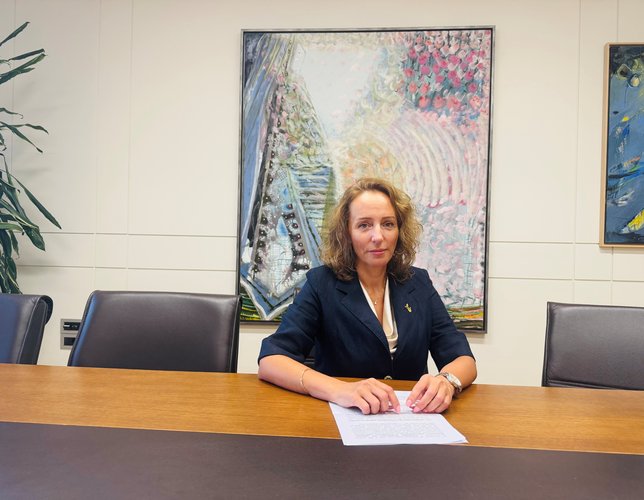
Delyana Ivanova to 24 Chasa Newspaper: BDB Saved the Funding for Building Renovation under the Recovery and Resilience Plan
This was the only legitimate option for Bulgaria, accepted by the European Commission, to preserve the funding for this investment. The bank guarantees the lawful and targeted use of these resources.
- BDB is once again in the spotlight following the selection of new management. What is the bank like today and what has changed over the past few years?
- When I joined the bank’s Supervisory Board in 2022, one of our first priorities was to increase transparency and make BDB a more visible and accessible institution. We established an Advisory Council to the Supervisory Board, bringing together all nationally representative employers’ organisations, the two trade unions and the National Association of Municipalities in the Republic of Bulgaria. All new products and key decisions of the bank are discussed by the Advisory Council, and we have always taken its members’ comments into account. We also receive positive feedback, as businesses, trade unions and municipalities are well informed about what is happening at the bank and how it is developing.
We commissioned Transparency International to conduct a review, which confirmed that the bank’s internal rules ensure transparency in its operations.
An important part of BDB’s transformation in recent years was its approval by the European Commission as an implementing partner under InvestEU. This means that the bank can work directly with InvestEU financial instruments. It is a significant recognition of BDB’s governance, systems and processes. Only 17 institutions across Europe have been approved, so this is a highly selective group. The bank underwent an extensive two-year accreditation and audit process by the European Commission.
To date, BDB has been entrusted with EUR 165 million, which is expected to mobilise approximately EUR 1.2 billion in financing for businesses.
The decision to entrust BDB with the management of European Commission funds under the Recovery and Resilience Plan for the energy renovation of multi-family residential buildings is both a recognition and a responsibility. This was
the only legitimate option for Bulgaria, accepted by the European Commission, to preserve the funding for this investment.
The bank guarantees the lawful and targeted use of these resources.
In terms of systems, procedures and working practices, BDB today is a transparent, well-organised and efficiently functioning bank. BDB has traditionally supported small and medium-sized enterprises and will continue to do so within the EUR 2.5 million limit set out in its Articles of Association. However, the relatively low level of this limit makes the bank’s business model more challenging and, at present, corresponds more closely to the financing needs of micro-enterprises than those of SMEs.
At the same time, BDB is an instrument for implementing public policies and supporting the government in financing strategic investors, investors certified under the Investment Promotion Act, public projects, and state-owned and municipal companies.
- Are there any exceptions to this limit?
- Only state-owned and municipal companies have been exempted from the limit. This enables the bank to support them in developing their activities and operating more sustainably.
There is also one area that is particularly important for Bulgarian industry – support for the defence industry. One of BDB’s statutory obligations is to finance exports. When it comes to manufacturing companies exporting their products, the limit does not apply.
The law also allows BDB to be entrusted with specific activities and projects under programmes and policies that are government priorities. In such cases, where larger-scale financing is required, the law allows the bank to provide loans exceeding the general limit.
- Should the limit be removed?
- I believe
the limit should rather be revised.
I do not see a need to remove it entirely, but there are market-based arguments for increasing it.
- What results have all these changes at BDB produced?
- The bank’s results have been improving over the past three years, and this trend continued in the first half of 2026. Over this period, the share of non-performing loans declined from just over 20% to below 9.5% as of June 2026.
It should be borne in mind that, because of the low lending limit, the new portfolio is growing more slowly and has much greater difficulty offsetting the ratio. If we exclude loans granted before 2021 and look only at the new portfolio, the ratio stood at 1.72% at the end of last year, compared with an average of 2.72% for the banking system. This shows that the bank has operated prudently and conservatively.
As a development bank, BDB
does not seek to maximise profit but passes the benefits on to its clients.
In other words, the bank is self-sustaining and does not operate at a loss, but unlike private commercial banks, its objective is not to maximise profit.
BDB’s annual profit is in the range of EUR 10–15 million, but what is more important to us is reducing the cost-to-income ratio, which stood at around 31% as of June, compared with an average of 35% for the banking system.
- One of the key tasks assigned to BDB is the building renovation programme. How far has its implementation progressed?
- The programme under the Recovery and Resilience Plan is a major challenge for us, but it is a national project supported by European funding, and we will deliver it. The deadline for signing the agreements is 31 August, and we have put the necessary arrangements in place to meet it.
Equally important is our role in overseeing the construction process and the absorption of funds, as well as ensuring proper implementation vis-à-vis the European Commission.
Under the first stage, we signed agreements covering 445 buildings. Around 200 additional buildings from the reserve list are expected to be included. This means that
approximately 640 residential buildings will undergo renovation.
In terms of gross floor area, this amounts to 1.3 million square metres to be renovated. This is particularly important because it has a direct impact on people’s quality of life and improves their living environment.
- Another focus of BDB’s work is support for farmers. Could the bank become the institution that facilitates their access to financing?
- BDB has a long track record of supporting agricultural producers through its subsidiary, the National Guarantee Fund. The scheme implemented so far had an initial resource of EUR 28 million, providing guarantees of up to 50% of commercial banks’ loan portfolios.
To date, the total amount of loans granted under this guarantee stands at EUR 137 million. This is a very good example of how a relatively limited
public resource, when targeted effectively, can mobilise nearly five times as much financing.
For the new programming period, following a legislative amendment and negotiations with the State Fund Agriculture and the Minister of Agriculture, we succeeded in agreeing on an 80% guarantee. This will provide even greater support for agricultural producers.
The programme covers agriculture in the broadest sense – livestock farming, crop production, and fruit and vegetable production.
The National Guarantee Fund is currently negotiating with commercial banks. They are expressing interest and indicating the volumes and amounts they would like to use for lending. This will broaden access to financing for a larger number of borrowers.
- It seems that, for the first time, a public competition is being held for new executive directors. Is this the right approach going forward?
- Until now, there has never been a public competition with an open selection process. The current format is consistent with our policy of transparency and an increasingly strong focus on professionalism.
We are also implementing the audit recommendations of the Bulgarian National Audit Office regarding this type of competition, ensuring that the process is public and transparent.
The vacancy announcement was published for one month. We received 27 applications, which represents considerable interest for a position of this kind. It is also evidence that the bank is a good place to work.
Thirteen candidates reached the final interview stage. Following the evaluation, the Supervisory Board selected three candidates, who were submitted to the Bulgarian National Bank in accordance with the prior approval procedure required under the Credit Institutions Act.
- Shouldn’t the state, as the bank’s owner, determine who will manage BDB?
- The owner appoints the Supervisory Board, while under the law the Supervisory Board appoints the members of the Management Board. In banking, the regulatory framework is very strict and sets high requirements for the professional qualifications and suitability of both supervisory and management bodies.
This particular procedure was necessary for institutional reasons. There is a decision of the Council of Ministers for one of the executive directors to take up a position at another international financial institution. By law, the bank must be represented by at least two executive directors.
The competition therefore had to be conducted within a timeframe that would ensure sound operational management of the institution and its lawful functioning.
- You joined the Supervisory Board when Alexander Pulev was Minister, but that was under a caretaker government. Is there an issue with the current Supervisory Board appointing new members of the Management Board?
- The Supervisory Board is the body that, by law, has both the right and the obligation to appoint the members of the Management Board.
The procedure was conducted in strict compliance with the law, the Articles of Association, the internal rules, the applicable regulatory framework and the recommendations of the Bulgarian National Audit Office.
For the first time, the selection process was open and public,
with criteria announced in advance and an opportunity for all candidates meeting those criteria to participate. Professional criteria and the interests of the bank were the guiding considerations in this competition.
The owner has the statutory right to determine the composition of the Supervisory Board. For as long as we serve our term of office, it is our duty to exercise all our statutory powers and take responsibility for our decisions.
Delyana Ivanova has more than 20 years of professional experience in the banking and financial sector. She has held senior management positions in the Bulgarian subsidiaries of leading international banking groups, as well as in major manufacturing companies. She served as Deputy Minister of Regional Development and Public Works from 2021 to 2022. She was a Member of Parliament in the 45th and 46th National Assemblies and a member of the Parliamentary Committee on Budget and Finance. She has been a member of BDB’s Supervisory Board since November 2022 and currently serves as its Chair.